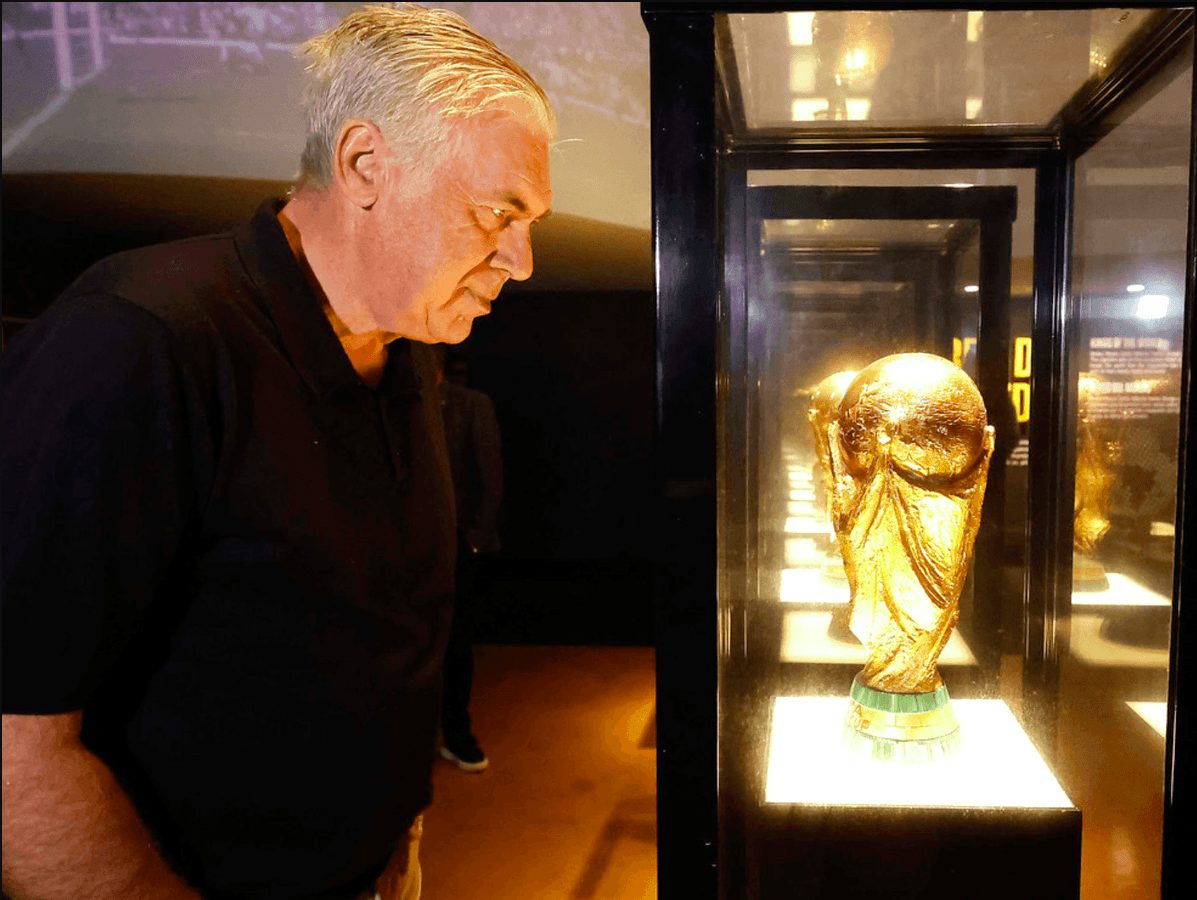
Carlo Ancelotti put it bluntly in March 2026: "The World Cup is won by whoever concedes the least, not whoever scores the most."
The remark arrived as context for his plan with Brazil, a team that spent the last two decades trying to outscore opponents in knockout rounds and getting eliminated every time. Ancelotti went further, citing the last two Brazilian titles as evidence: "With Felipao and his three centre-backs in 2002, for example, and in 1994 Parreira set up two banks of four to make the most of Romario up front."
It is a testable hypothesis. Eight World Cups from 1994 to 2022 give us eight champions, each with a complete seven-game record. Here is what the numbers show.
| Year | Winner | GP | GF | GA | GA/Game |
|---|---|---|---|---|---|
| 1994 | Brazil | 7 | 11 | 3 | 0.43 |
| 1998 | France | 7 | 15 | 2 | 0.29 |
| 2002 | Brazil | 7 | 18 | 4 | 0.57 |
| 2006 | Italy | 7 | 12 | 2 | 0.29 |
| 2010 | Spain | 7 | 8 | 2 | 0.29 |
| 2014 | Germany | 7 | 18 | 4 | 0.57 |
| 2018 | France | 7 | 14 | 6 | 0.86 |
| 2022 | Argentina | 7 | 15 | 8 | 1.14 |
Three World Cup winners since 1994 conceded just two goals in seven games: France 1998, Italy 2006, and Spain 2010. Those remain the three best defensive records in tournament history for a champion. In the case of Italy 2006, neither of the two goals conceded came from open play (one own goal, one penalty). Buffon was never beaten by an opponent's shot across seven matches.
Six of the eight modern winners conceded four or fewer goals. Six of the eight finished with a goals-conceded-per-game average below 0.60.
The average goals conceded per game across all eight winners is 0.55. Across all eight runners-up in the same period, the figure is higher. The pattern is consistent enough to qualify as a trend, not a coincidence.
Argentina 2022 broke the pattern. Scaloni's side conceded eight goals in seven matches, including two against Saudi Arabia, two against the Netherlands, and three against France in the final. That 1.14 goals per game is more than double the average of the other seven winners.
But the margins tell a different story. Argentina needed a penalty shootout in the quarterfinal after Wout Weghorst scored twice for the Netherlands in the final minutes, the second arriving at 90+11'. They needed another shootout in the final after Mbappe scored a hat-trick to force extra time. A team that concedes eight goals and survives only because of penalty-shootout composure is not a counterargument to Ancelotti's theory. It is the exception that nearly collapsed under its own weight.
Scaloni himself acknowledged this after the tournament: his 2022 side attacked brilliantly but lived dangerously at the back. Mbappe's first two goals in the final came 97 seconds apart, turning a 2-0 deficit into 2-2. His third arrived in extra time to force penalties. Then, in the final seconds of extra time, Kolo Muani found himself one-on-one with Martinez. A goal in that moment would have given France the trophy without penalties. Martinez stopped it. A defence that concedes three goals and survives a last-second one-on-one in a World Cup final is not a defence built for tournament football. It is one that got away with it.
Ancelotti's citation of Brazil's last two titles is precise.
1994: Parreira's Brazil was built on a double pivot of Mauro Silva and Dunga, the captain, screening a back four that conceded three goals in seven games. Romario scored five, but the structure behind him made those five enough. Brazil trailed only once, for 24 minutes against Sweden in the group stage before Romario equalized.
2002: Scolari deployed three centre-backs (Lucio, Roque Junior, Edmilson) behind Cafu and Roberto Carlos. Gilberto Silva sat in front. That team scored 18 goals, tied with Germany 2014 for the most by any champion since 1970, but they also posted four clean sheets. The 3-5-2 was a defensive chassis that happened to carry Ronaldo, Rivaldo, and Ronaldinho.
Compare those two campaigns to the World Cups Brazil lost. In 2014, the 7-1 semifinal against Germany came after David Luiz and Dante were left exposed by a nonexistent defensive midfield. In 2018, Tite's side conceded from a Belgian counter-attack in the quarterfinal because Fernandinho was dragged out of position. In 2022, Croatia went 116 minutes without a single shot on target against Brazil. Petkovic's deflected equalizer at 117' sent the match to penalties. Brazil's defence could not hold a 1-0 lead with three minutes of extra time remaining.
The diagnosis is consistent. When Brazil wins World Cups, the defense is organized. When they exit, it is not.
Ancelotti's philosophy makes sense. Drilling it into a back line he gets for days at a time is the challenge.
Brazil's 26-man squad, announced on May 18 at Rio's Museum of Tomorrow, settled the defensive picture, and it settled it more favorably than the spring projections suggested. Alisson is fit and starts in goal. Marquinhos is in and wears the armband. Gabriel Magalhães made the list. The pre-tournament talk of a back line stripped to its reserves did not survive the official squad.
The probable back four in front of Alisson: Wesley (Roma), Marquinhos (PSG), one of Gabriel Magalhães (Arsenal) or Bremer (Juventus), and Douglas Santos (Zenit). Four of those five play in Europe's top five leagues.
| Team | Top CB | 2nd CB | GK | DM Screen |
|---|---|---|---|---|
| England | Guéhi (Man City) | Konsa (Aston Villa) | Pickford (Everton) | Mainoo (Man Utd) |
| France | L. Hernandez (PSG) | Lacroix (Crystal Palace) | Samba (Rennes) | Kanté (Fenerbahçe) |
| Spain | Huijsen (Real Madrid) | Mosquera (Valencia) | Raya (Arsenal) | Rodri (Man City) |
| Brazil | Marquinhos (PSG) | Gabriel Magalhães (Arsenal) | Alisson (Liverpool) | Casemiro (Man Utd) |
| Germany | Schlotterbeck (Dortmund) | Tah (Leverkusen) | Nübel (Stuttgart) | Kimmich (Bayern) |
On the employer column, Brazil now reads like its rivals rather than below them. Marquinhos starts for PSG, Gabriel for Arsenal, Alisson for Liverpool. France lost Saliba and Koundé to injury and start L. Hernandez (PSG) and Lacroix (Crystal Palace). Germany replaced Ter Stegen with Nübel at Stuttgart. Spain start Huijsen at Real Madrid but pair him with Mosquera from Valencia. The club-level gap that defined Brazil's defense in earlier projections has closed.
The problem is no longer where these players are employed. It is that they have barely defended together. Marquinhos has a drilled partnership at PSG, but not with Gabriel or Bremer, and the two Brazil centre-backs have not been a settled pair for the national team. Ancelotti has to build that understanding in days.
The one genuine absence is Militão, still out injured. He would have been the natural partner for Marquinhos and was the only Real Madrid centre-back in the pool. Beyond him, the squad Ancelotti wanted is the squad he got.
The defensive midfield is a separate concern. Casemiro is 34 and no longer plays for a Champions League contender at Manchester United. Germany have Kimmich at 31, still at Bayern. Spain have Rodri at Man City, returning from a long-term knee injury. France start Kanté, 35, now at Fenerbahçe. No contender has an ideal option at the position, but Casemiro's combination of age and declining club context is the weakest hand.
"I don't like being called defensive, but it's key for the team."
Ancelotti's club record backs the philosophy. His Real Madrid conceded 31 goals in 38 La Liga games in 2021-22, second only to Sevilla, and then led the league with 26 in 38 games in 2023-24. Courtois, Carvajal, Militao, Alaba, Mendy, Casemiro. That was a defensive unit built on understanding and repetition.
International football allows neither. Ancelotti has had 10 matches and a 50% win rate (5W-2D-3L). His centre-backs are proven in Europe but have not played together regularly. His defensive midfielder is past his peak. The tools that served him at Real Madrid (daily training, familiar partnerships, tactical drills over months) are unavailable in a job where he gets the squad for days at a time.
The early defensive returns argue against him. Ancelotti's Brazil has conceded eight goals in those 10 games, 0.80 per match. That is well above the 0.55 average of the eight World Cup winners since 1994, and higher than every champion in this study except France 2018 and Argentina 2022. It came against friendlies and qualifiers, a softer schedule than the one waiting in June. The coach who says tournaments are won by conceding least is, so far, not winning that battle with Brazil.
Five Champions League titles tell us Ancelotti knows how to set up a defence. The question is whether he can do it with four days between group matches and a centre-back pairing his players have never started as one.
Ancelotti is right. Six of the last eight World Cup winners conceded fewer than five goals. The three most dominant defensive records in modern tournament history belong to champions. Every Brazilian title from 1994 to 2002 was built on a defensive structure, and the pattern holds for 1958 and 1962. Only the 1970 side, which conceded 1.17 goals per game, broke the mold with a generational attack.
The theory is sound. The squad is stronger than the spring projections suggested. Marquinhos is world-class, Gabriel Magalhães starts for a Premier League title contender, and Alisson is among the best goalkeepers in the tournament. The weak point is not league pedigree. It is cohesion: a centre-back pairing with no club-level reps, behind a defensive midfield built around a 34-year-old.
Brazil still enter the 2026 World Cup behind the top European contenders and Argentina in prediction market pricing. But the defensive line is no longer the gap it looked like in April. Ancelotti diagnosed the right problem, and the May 18 squad gave him the personnel to address it. Whether he has the time to drill a new centre-back partnership will define Brazil's tournament.
